
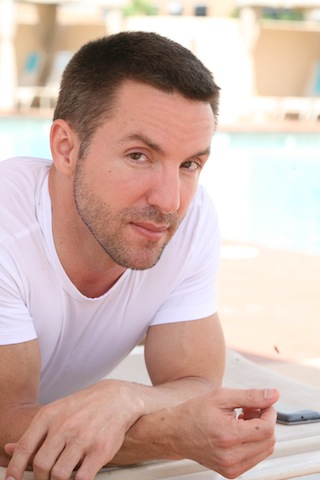
DP: So where does your story begin?
MC: I was born to parents to who didn't really want me, and attachment disorders and abandonment issues--which we don't think about until we become parents ourselves, I guess. So I spend the first year and half or so, with my birth parents and they break up, and for a short while, I end up living in a commune in New Mexico with group parenting. I wind up getting adopted, and spending three through eight in an abusive household; it was pretty intense. This couple, makes a living in working with drugs. They break up and split and I wind up couch- surfing from boyfriend to girlfriend for the next five years. After this, I run away and end up getting at a construction site picking up trash--it was a good job, I was getting five bucks an hour, cash. So that's $10,000 a year, so for a young man, 14-years- old, I felt like all my problems were completely solved. $10,000 a year!
I ended up learning some trades--the masons picked me up and I learn how to mix mortar, the carpenters picked me up and I learn how to swing a hammer, and I do that for a few years. Some electricians pick me up--I'm trying to apply myself to prepare for a skill trade. The outfit I'm wearing winds up getting a job helping out with the electric work at the poster office, so I end up joining the union as an apprentice.
It's been a few years, and I'm kinda stalling out, and I realize I'd like to do something else. I'd like to work indoors for one thing, it's hot out here. So I go down to Glendale Community College, and tell them this story, and say here's the deal, I'd like to go. And they ask me about high school and I tell them, I finished eighth-grade and ran away. So I get a GED. I took classes at GCC, and I took so many classes that in 1990, I had the third-highest number of credits that GCC ever had. I studied everything.
DP: Is that pure curiosity and hunger to learn and dive in?
MC: Yeah. I studied marketing, accounting, religion, and settled in engineering because I figured I needed to make money and earn a living. Then transferred to ASU. I always wanted to continue to apply myself, and I still do. I'm in the process of applying for the PHD program in sustainability, I just have a craving to continue to grow.
DP: That's an incredible and unique thing. It's refreshing to have an a curiosity to want to continue to learn and expand and position yourself on a path to led to something else.
MC: Yeah. I always felt that, perhaps that I was not worthy of being alive. I almost gave up a few times, until I thought, "Well I'm here, I might as well do something." And I got this sense that I really wanted to make it count, I wanted to make the pain I had felt worth something. The best thing way I could think was to make it worth something was and to try to make other people's lives better. It seems like my life has been figuring out how I can apply myself in order to help others.
I want humans to treat each other more humanely. That's what I do today., I try to solve problems and do so in a way that it gets to this chewy center in a way.
DP: Is that how the term "concierge attorney" came about?
MC: I was trying to figure out how I could convey to people what I do because it's not that I really provide legal advice. It's more like I provide whatever it is I think I know about the situation. It can be strategic advice, business advice, or life experience advice. I'm usually looking to see what's really happening, and what's this person, that I'm working with seemingly need. A lot of people don't take the time and say, "Here's a set of documents and sign, here." I think of myself like a concierge physician— the old kind that makes house calls. I really want to try to seek you out--what's going on, what can I provide, let's figure out a plan and spend an hour and say what we need is this person who does this and we'll make those calls and set up meetings.
DP: Is that the type of ideal that your firm embodies?
MC: In a sense that I want to give people the best solution. If we need something like that then it's exactly an ideal. But there are times where I'm the right person because it's a question of if I'm the right person to remain engaged.
