Inspired by the Puget Sound, this Phoenix couple built a second home in Washington State that is symphonic and spiritual—a Northwest getaway that celebrates their passions for music, nature and faith. The end result is the perfect year-end and year-in present for themselves, and for family and friends.
Just outside of bellingham, the largest city in Whatcom County, the 3,465-sq.-ft. home rests on just less than an acre, sloping down 30 percent from the entry, facing east, to an escarpment 60 feet above Puget Sound on the west.
Designed by CCBG Architects of Phoenix and San Diego, the regionally inspired home—a trio of highly articulated wood structures—comprises four bedrooms, including a semi-separate 350-sq.-ft. guest suite, three and a half baths and an 800-sq.-ft. three-bay garage pavilion.
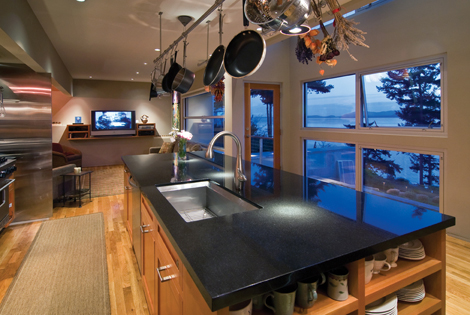
This home is just right for celebrations. Open and welcoming, it’s designed for family gatherings and entertaining friends—one that unostentatiously celebrates success and togetherness. Just off the kitchen, for example, is a small space to chat while meals are being prepared. Beneath the living room, at the lowest level of the home, is a wine cellar and a theater with stadium seating.
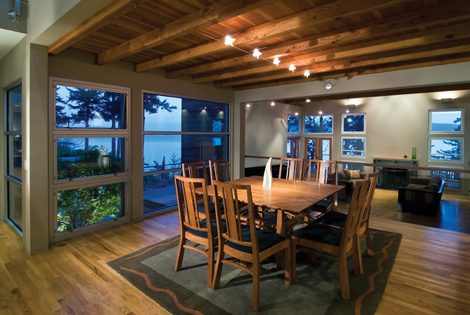
A space fit for entertaining is appropriate, as both husband and wife are trained as musicians (she’s a retired cantor) and the dining and living rooms are designed to accommodate mini-concerts and musical performances. The couple has hosted several in the living room, including the soloists from the Bellingham Festival of Music, called “Sunsets and Sonatas.”
“The house is graced with framed posters of many of my concerts with my alma mater’s symphony orchestra,” says the husband, who has bachelor’s and master’s degrees in music in addition to his medical degree. Music is everywhere in the home: Even family boats have musical names, starting with the Handelian “Water Music,” to the current “Sea Major, Opus 3.”
Just outside, the views of Puget Sound offer its own music of water and light. Another 1,500 square feet of decks and covered walkways showcase the spectacular location. To the west is the Sound—the fjordlike system of bays explored in 1792 by George Vancouver and named for Lieutenant Peter Puget, one of his officers. To the northwest are the snow-capped Olympic Mountains, peaking at almost 8,000 feet.
The couple lives about seven months in Arizona and five summer months in the cool Northwest weather. “About a decade ago, we visited a friend in Bellingham during a vacation,” the husband says. “We immediately loved the area and decided to look into finding a lot here.” They take intermittent weekends occasionally as well, meeting with two of their three children, students at the University of Washington in Seattle; the children also drive up on their own once in awhile, to respite from campus and city life.
When the couple decided to build, they approached CCBG’s Kym Billington, who designed the synagogue they belong to in Phoenix. A design process of two years followed, then two more years for construction.
The home is built on four levels—incorporating a 25-foot change in elevation from the streetside entry to the backyard. Onsite are granite boulders, volcanic rocks, cedar and Douglas fir trees; the couple asked Billington to disturb the setting as little as possible during construction.
Designed to give the appearance of refined simplicity, the home uses stacked and expressed timber detail as well as unadorned and uncolored wood cladding. To maintain this regionalist sensitivity within, custom cabinetry, casework and timberwork incorporate cedar and fir grown and milled in the Northwest. “We had hoped not only to give honor and dignity to the timber that once stood on this site, but also to give warmth and a tactile feel to the experience as one passes beside, between, beneath and through the structures,” Billington says.
“The couple and I had talked at length after seeing the site about different ways of thinking about placing a building on a site like this,” Billington recalls. They discussed the varying spiritual elements of the location and ways that would best unfold its magic. They thought of Shinto Shrines and Zen tea houses of Japan: “These sometimes obscure themselves, being revealed slowly through a series of changing axial movements, goals and rewards that lead one through the structure and the landscapes beyond,” Billington says. “The structures reveal themselves in an intimate ‘scenographic’ fashion—much like the structure of a movie or of a piece of music—rather than merely as an object standing in space.”
Billington adds, “In moving through a structure in this fashion, opportunities—events—present themselves to experience both the macro as well as micro environment surrounding and within the house—one of the clients’ goals.”
As a result, each of the three structures—the garage pavilion, the main house and the living pavilion—rises to a simple pitched roof with projecting eaves, and each is set parallel to the site’s descending contours. A somewhat offset T-shape is the resulting configuration, with the largest section, the main house, serving as the north and south horizontal element.
