Manhattan: Meet the desert.
Douglas and Sonia Bendt often stroll from their penthouse to the landmark Arizona Biltmore Resort & Spa in Phoenix. The journey is just across a stone bridge over the historic Arizona Canal, part of a system originally dug by the Hohokam Indians to green the desert more than a millennium ago. The Bendts’ 3,190-sq.-ft. home is part of the Fairway Lodge at the Biltmore, a two-phase project designed by the Tempe office of RSP Architects and developed and marketed by Phoenix-based Geneva Holdings.
Inspired by contemporary furniture designer Ludwig Mies van der Rohe, the Bendts’ three-bedroom home is crisply articulated, airy and filled with light. It’s a showpiece space that’s elegant and at the same time open-armed, which is fitting as the gregarious Bendts are frequent entertainers. She’s an interior designer; he’s a mortgage and real estate investment advisor; and they live primarily in New York City. For now, their Arizona getaway is sunshine, elbow room and strolls to wine-tastings at the hotel. In time, this will become their retirement abode.
“We wanted to live in a sophisticated community in the best location and yet have easy access to all the things we love—museums, the art scene, shopping and fantastic restaurants,” says Sonia, a New York City native who holds a certificate from the prestigious New York School of Interior Design. Born in Wisconsin, Douglas has lived in New York City for 28 years. In 1993, they met in the city and three years later they exchanged vows atop Aspen Mountain in Colorado, as two eagles soared above them, she recalls.
They moved into the home in October of 2007. “I love the hectic pace of New York City, but when I arrive at the Biltmore and see the open space and the views, I fall in love with it all over again,” Sonia says. “And, I think the second Doug walks in when we arrive from New York and he sees the golf course, he smiles just thinking that he will soon be playing his favorite sport!”
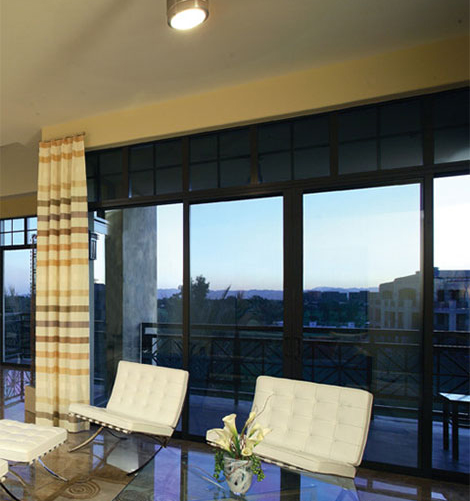
From three balconies looking south, they see the resort’s Adobe Golf Course, the community pool and spa, and the city lights. Two additional balconies, at the den and guest room, look north toward the Biltmore and up to the Phoenix Mountain Preserve and Piestewa Peak. “There’s really nothing like it in New York City, but the closest equivalent is Fifth Avenue or Park Avenue,” Douglas says.“The key reason we decided to buy was because we knew this site can never be duplicated and it will never have the views obstructed,” Douglas says, who also touts the home’s immediate proximity to the outstanding community clubhouse and gym. In recognition of the unique location, the developers tied the architecture to that of the Wright-inspired Biltmore by using similar tiling, railing and other details. Notably this year, the hotel celebrates its 80th birthday.
When the Bendts enter their spacious residence, they breathe deeply and look outside and inside. “Space is the ultimate luxury for a New Yorker, and that is why we kept our Biltmore place open and uncluttered,” Sonia says. In particular, they like the high ceilings and the wall-to-wall glass doors because these elements are conducive to openness—a fitting reminder that they are not in New York City anymore.
“Everyone who has walked into our home loves the airiness of the space and the open-plan layout,” Sonia says, who returned to school for interior design because real estate clients of hers kept asking how they should coordinate their homes—even after working with professional interior designers.
In the early morning for coffee, or late in the evening for wine, the Bendts sit in front of the large bay window looking south over the golf course. For conversation with friends, they usually choose the living room—especially in the cool of the desert nights. “I love turning the gas fireplace on,” Sonia says. And, for entertaining, everyone is attracted to the open kitchen with its large wrap-around bar and four contemporary Brueton stools finished in a square-motif material from Stark Fabrics.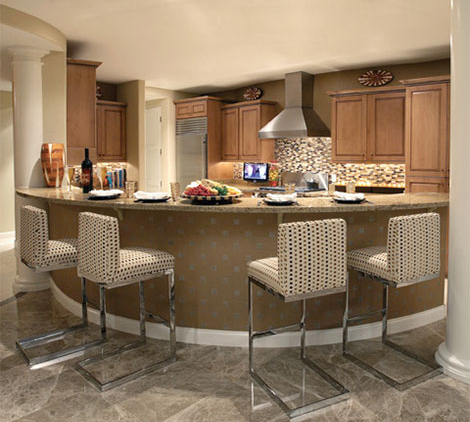
Contributing to this spaciousness is the selection and placement of the furniture and accessories. Modernist without being cold, the interior relies on individually selected pieces from classic 20th century masters as well as contemporary pieces from New York City and Arizona artists and designers.
Sonia’s cues come from the Bauhaus and international styles and Wrightian organicism. These influences translate into clarity, simplicity, sculptural lines and individual pieces coordinating with the whole. Her historical mentors are Ludwig Mies van der Rohe and Florence Knoll. “My attention to detail, clean lines and fondness of modern classic furniture came about as a result of studying the classics and learning, indeed, that ‘less is more,’” she explains, referring to the famous Mies dictum. “After studying Mies’s work and loving his ideas, I was motivated.”
She adds: “I am not a fan of cluttered spaces and believe that if you invest in the best materials, furniture and clean lines, you will be able to live with your home for a very long time.” At the same time, Sonia coordinates every piece—art, fabric, furniture, even flowers. “To create a completely harmonious environment, everything has to be thought out,” she says.
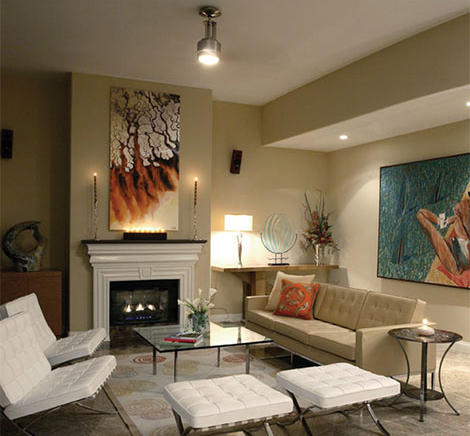
In the living room, for example, a three-seat tan Florence Knoll sofa and two white-leather Ludwig Mies van der Rohe Barcelona chairs and two benches surround a Mies-designed Barcelona “X” glass-and-polished-steel table, so called because of the surface framing. On the open side is the gas-fired stone fireplace, which delivers the warmth the Bendts so enjoy.
“I love the Barcelona chairs, which have been described as ‘art you can sit in,’” Sonia says. Modern classics, the chairs and the table were custom-designed in 1929 for the German Pavilion at the World Exposition in Barcelona; the king and queen of Spain sat in the originals during the event. On a chrome-plated steel frame that “floats” the chair cushion, the iconic chair is a product of Mies’s years at the Bauhaus, which the Nazis forced to close in 1933. The Mies pieces are all authorized and manufactured by Knoll. “I chose them because I love the clean elegant lines,” she says.
Straddling the fireplace are two wood pieces offering a contrast in materials. On one side is a fruitwood burl stereo cabinet topped by a Himalayan jasper sculpture by Pan Qiqun. On the other is a walnut “Z” console, whose legs loosely form that letter.
Among the accessories on the table is a circular glass sculpture by Arizona artist Peggy Pettigrew Stewart, which continues the geometric theme beginning in the foyer with the mosaic-tile-floor pattern that repeats throughout.
A polished white-bronze Margaret Lamp by Lyle and Umbach also adds to the sculptural lines.
The focal point of this room, however, is the artwork, “Ganges River Delta, India” by Valley artist Stuart Anthony Black. A dramatic mixing of satellite image photography and artistry, Black’s piece depicts, in oranges, whites and earth tones, a 100-square-mile region during the monsoon season when the Ganges River roils huge amounts of sediment into the sea.
“I take raw satellite measurements of infrared light being reflected and emitted from the Earth’s surface and merge this data to create abstract, pseudo-color interpretations of the world’s most spectacular geographical features,” says the artist, whose Pangea Gallery is in Scottsdale. A signature design gesture, Sonia wrapped a pillow in a Hermès scarf she found in the Madison Avenue store and picked up some of the colors in the Black artwork; this rests on, and contrasts with, the Knoll sofa.
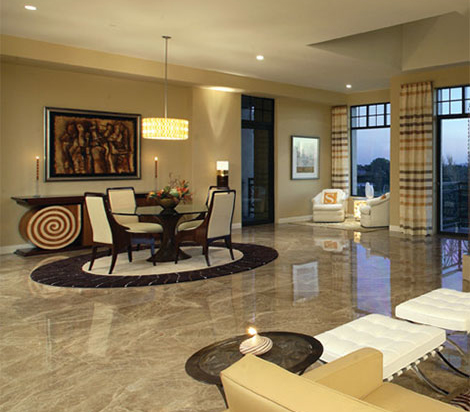
This flow continues in the adjacent dining room, which boasts a “Verona 92” credenza bearing a swirling design. Contemporary Italian designer Luca Scacchetti designed the combination birch, cherry, mahogany and walnut end piece. A round glass table sits on a contemporary-style round wool rug, and the cylindrical lighting fixture reinforces this circularity.
“We chose this artsy credenza because it is elegant and playful at the same time,” Sonia says. “That is what I want the interiors I design for my home and elsewhere to be: stylish, elegant, and yet not too serious.”
Smiling, she points to the oil painting above the credenza: “Cuatro Mujeres En Silencio” (“Four Women in Silence”) by Hilario Olivia from Santo Domingo, Dominican Republic. “I loved the title and the art because I am always talking and I thought it was hysterical that I liked a painting that was the quiet, silent type.”
Doug lounges in a Barcelona chair and chuckles, quietly.
