Inspired by Puget Sound, a Phoenix couple has built a getaway home in Washington State that is symphonic and spiritual—celebrating their passions for music, nature, family, faith.
Designed by CCBG Architects of Phoenix and San Diego, the regionally inspired home—a trio of highly articulated wood structures—comprises four bedrooms, including a semi-separate 350-sq.-ft. guest suite, three and a half baths and an 800-sq.-ft. three-bay garage pavilion.
This is a home designed for family gatherings and entertaining friends—one that unostentatiously celebrates success and vibrantly celebrates togetherness. Just off the kitchen, for example, is a small space to chat while meals are being prepared. Beneath the living room, at the lowest level of the home, is a wine cellar and a theater with stadium seating.
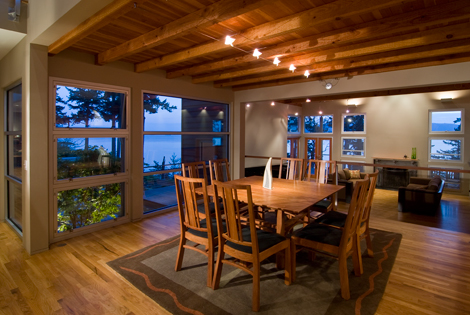
So, too, as the professional couple are both trained as musicians (she’s a retired cantor), the dining and living rooms were designed to accommodate mini-concerts and musical performances. The couple has hosted several in the living room, including the soloists from the Bellingham Festival of Music, called “Sunsets and Sonatas.”
“The house is graced with framed posters of many of my concerts with my alma matter’s symphony orchestra,” says the husband, who has bachelor’s and master’s degrees in music in addition to his medical degree. Music is everywhere in the home: Even family boats have displayed musical names, starting with the Handelian “Water Music,” to the current “Sea Major, Opus 3.”
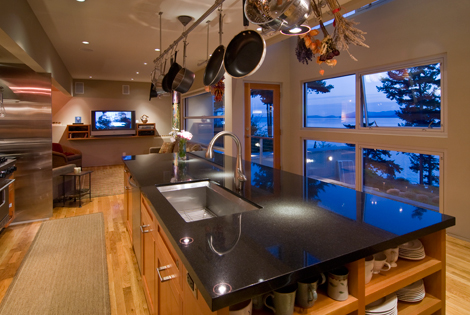
Just outside, the views of Puget Sound offer its own music of water and light. Another 1,500 square feet of decks and covered walkways showcase the spectacular location. To the west is the Sound—the fjordlike system of bays explored in 1792 by George Vancouver and named for Lieutenant Peter Puget, one of his officers. To the northwest are the snow-capped Olympic Mountains, peaking at almost 8,000 feet.
The couple stays about seven months in Arizona and five summer months in the cool Northwest weather. They take intermittent weekends occasionally as well, meeting with two of their three children, students at the University of Washington in Seattle; the children also drive up on their own occasionally, to respite from campus and city life.
“About a decade ago, we visited a friend in Bellingham during a vacation,” the husband says. “We immediately loved the area and decided to look into finding a lot here.”
They approached CCBG’s Kym Billington, AIA, who had designed the synagogue they belong to in Phoenix. A design process of two years followed, involving conversations from eco-sensitivity to spirituality to the home’s position on the site. Two more years followed for construction.
“We wanted him to create a life space that brought some of that same spiritual presence to our home,” Billington explains. “There are times that simply by either looking outdoors or standing on the deck, you can be drawn into nature in a way that approaches a religious experience. Watching the cloud banks drift by or the sun set over Vancouver Island can make it difficult to be an atheist.”
The home is built on four levels—incorporating a 25-foot change in elevation from the streetside entry to the backyard. Onsite are granite boulders, volcanic rocks, cedar and Douglas fir trees; the couple asked Billington to disturb the setting as little as possible during construction.
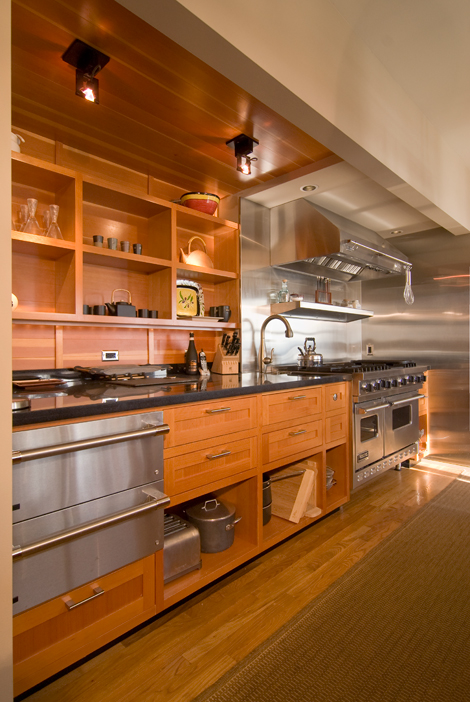
Designed to give the appearance of refined simplicity, the home uses stacked and expressed timber detail as well as unadorned and uncolored wood cladding. To maintain this regionalist sensitivity within, custom cabinetry, casework and timberwork incorporate cedar and fir grown and milled in the Northwest. “We had hoped not only to give honor and dignity to the timber that once stood on this site, but also to give warmth and a tactile feel to the experience as one passes beside, between, beneath, and through the structures,” Billington says.
“The couple and I had talked at length after seeing the site about different ways of thinking about placing a building on a site like this,” Billington recalls. They discussed the varying spiritual elements of the location and ways that would best unfold its magic.
They thought of Shinto Shrines and Zen tea houses of Japan: “These sometimes obscure themselves, being revealed slowly through a series of changing axial movements, goals and rewards that lead one through the structure and the landscapes beyond,” Billington says. “The structures reveal themselves in an intimate scenographic fashion—much like the structure of a movie or of a piece of music—rather than merely as an object standing in space.” He adds, “In moving through a structure in this fashion, opportunities—events—present themselves to experience both the macro as well as micro environment surrounding and within the house;one of the clients’ goals.”
As a result, each of the three structures—the garage pavilion, the main house and the living pavilion—rises to a simple pitched roof with projecting eaves, and each is set parallel to the site’s descending contours. A somewhat offset “tee” shape is the resulting configuration, with the largest section, the main house, serving as the north/south horizontal element.
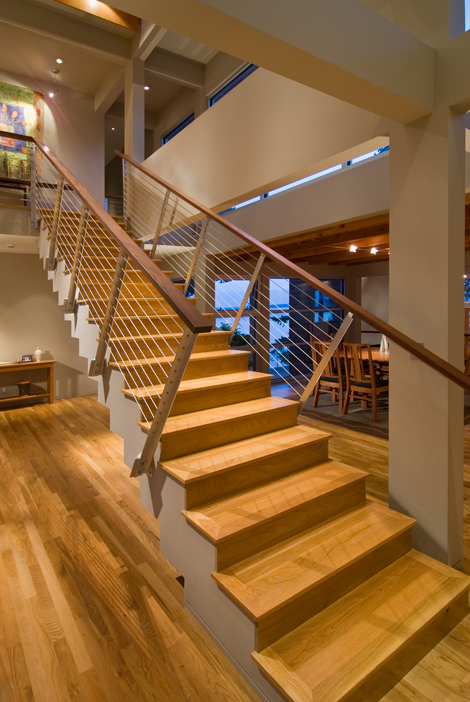
Almost invisible from the small neighborhood street, the home invites guests along a sloping walk past the garage to a stair down to the front door —natural progressions because of the descending topography.
“The entry and passage through the building is intentionally protracted and perhaps even convoluted as one moves from ‘goal to reward’—from the upper reaches of the site to the edge of the cliff below,” Billington explains. “In the process, the nature of the home is revealed.”
Just at this angle, as the primary entry walkway turns right to the stairs, Billington has placed a small niche opening which offers a glimpse through the main house to Puget Sound—a hint of the focal point view. This continues elsewhere, so that windows facing the Sound are at places of transition, along pathways, in hallways and entry ways, on stairs, between rooms and in corners. Other view windows focus on the sky. “Windows become clues, adding to the complexity of moving through the simple forms and experiencing the site,” he says.
Even the west wall of the living room, facing the Sound over the open deck, is fitted with punched openings, partially obscuring the view or framing micro views, depending on location in the room. As the area is a Zone 3 seismic area, large expanses of glass here would have been expensive as well as uncomfortable during the cold winters.
They borrowed a concept—the “Zen view”—from Christopher Alexander’s book, “A Pattern Language.” Billington says, “He describes a remote mountain hut occupied by a monk in which there was a narrow slit cut through the thick stone wall through which one could see a distant view of the ocean. That was the only window facing the view and because of the thickness of the wall, one could only see it if one intentionally stood directly before it. In other words, you had to want to see it.” This achieved view is, then, always special, never mundane and never forgotten.
“One afternoon, we were holding rehearsal in the living room for the synagogue choir, and I noted that a magnificent sunset over the Sound was occurring,” the husband recalls. “We stopped rehearsal, taking everyone out on the deck—and we recited the blessing for experiencing a miracle.”
Kym Billington On…
The home’s design style: Contemporary Northwestern interpretation.
Favorite room: The dining room. It is the heart-center of the house and the room where friends and family come together for laughter and conversation.
The most unique part of the home: The entry sequence/entry hall. It is the antithesis of the McMansion-power entry in its subtle, protracted and Zenlike quality.
Biggest Challenge: The site topography. A 30 percent slope below the street level, and the desire to maintain the natural site profile while keeping the house livable created great difficulties.
