Life is grand at this Tucson estate, thanks to an in-house theater and a pub-style game room.
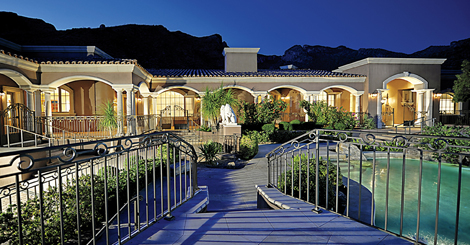
Begun in 1999 and finished in 2005 by Tucson-based Hallmark Custom Homes, the two-level comprises 23,662 square feet under roof—and stars an award-winning retro-style theater and a 15-car auto gallery with a turntable built into the floor.
The home’s extraordinary details include hand-carved and antiqued cornice moldings, Clive Christian cabinetry, a mahogany and brass elevator that resembles the one in “Pretty Woman,” and a living room marble fireplace imported from France. Coved and domed ceilings carry artist-painted scenes lit by computer controls, and many spaces are designed around pieces the couple acquired just for the home. “We made many trips to Beverly Hills, where our interior designer, Ron Hefler, lives, picking out one-of-a-kind antiques which the home was built around in many cases,” the wife explains, noting that the home is starring on an upcoming episode of “Million Dollar Rooms” on HGTV.
The family-friendly custom home, designed by Seaver Franks Architects, also of Tucson, is on a 1 ¾-acre cul-de-sac lot in the guard-gated Canyons community. Luxury amid lush desert, the home looks up to the Santa Catalina Mountains and out to the Tucson Basin and city lights. Everywhere, day or night, inside or out, is drama. “This European-style estate is sensational, seductive, stunning and spectacular, with opulent finishes and magnificent décor,” says Frank Aazami, of the Private Client Group, for Russ Lyons’ Sotheby Scottsdale.
The four-bedroom, 12-bath custom abode features a daily three-car garage space and an adjacent auto gallery. The 5,000-sq.-ft. air-conditioned car vault—doubling as a Fortress of Solitude—incorporates a 20-foot-diameter vehicle turntable inlayed into the color-stamped concrete floor, allowing for desired placement and removal of a particular car. Specialty lighting highlights each classic as desired.
The Canyons home offers other spaces not often seen—even in luxury homes of the same echelon: maid’s quarters with kitchenette; a nursery; a full guest suite with living room and kitchenette; and a children’s playroom. The master bath has a fireplace with marble surround as well as a Jacuzzi-style bath tub with a flat-screen television, two gold-leafed sinks, marble floors and antique lights.
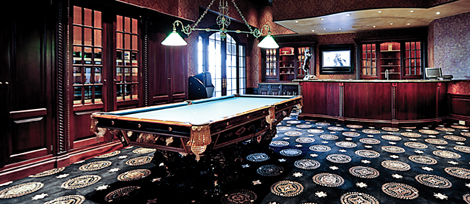
The couple often retreats to an English pub/game room. The wool carpet in the pub, and the throw rugs in the dining and living rooms, were hand-sewn in China, requiring two years of painstaking work. The pub carpet also has custom-designed lion heads worked into it. The pub features brass and glass double doors, a swirling ceiling motif and a bar with gold-plated fixtures. Lastly, the room’s centerpiece is an original antique Brunswick pool table.
In addition, their home features guest quarters with a separate entrance, a piano room and an exercise room with a sauna and tanning and massage rooms. Rear-yard luxuries include an infinity-edge pool and a spa; a created bridged stream runs between them. A Viking barbecue and a pizza oven add to the desert-lifestyle amenities.
The work and show kitchens include two Sub-Zero refrigerators, two Sub-Zero freezers, two dishwashers, two stand-alone ice makers and two Viking oven/ranges. A breakfast bar and breakfast room are adjacent. The couple have also planned for a future wine cellar. “The architectural design evolved with a distinctive pallet of stucco massing, accented with cast-stone detailing and variegated red clay mission tile roofs,” says Mike Franks, AIA, principal of Seaver Franks Architects. “The resulting Spanish Colonial architecture seemed to be the perfect solution for this desert location.” The structure he programmed is solid: masonry, concrete and steel beams.
Designed to resemble an early mid-20th-century movie house, the family theater accommodates 16. The room required extensive coordination; it was finished four years before most of the home in order to be entered in the 2004 CEDIA awards. One of the couple’s favorite rooms, it won for best home theater in the United States. The husband and wife coordinated with many vendors on the space. The architect, Franks, provided preliminary sketches, and Theo Kalomirakis Theaters, the well-known theater designer in New York, finished the design. They also worked with a Canadian company to build the plaster elements. In California, they consulted with the interior designer, Hefler; Murray Kunis of Future Homes, the Los Angeles-based audio-video company; and the fabric manufacturer and the artists doing the canvas work. Finally, Todd Iman, principal of Hallmark Custom Homes, helped coordinate the local vendors and subcontractors.
Iman collated all of the theater designs and ensured that the parts coordinated. For example, he redesigned the ductwork for the heating and cooling to fit into the architectural elements, like columns, column bases and groin vaults. He adds: “I don’t like seeing vent grills, so I constructed all the air returns in the floor under the seating, and the air supplies are hidden behind the vaults.”
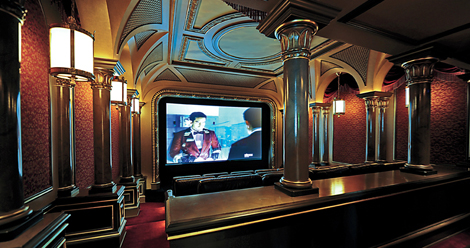
The arched ceilings and other architectural elements for this room were made in Canada from a plaster-type material poured into molds. The individual components, designed by Kalomirakis, were shipped to Tucson, assembled on site and antiqued and painted with gold leaf for an Old World feel. “It took two painters working eight to 10 hours a day for two months to paint the theater alone, not including any of the gold leaf or canvas painting work,” Iman explains.
Similar meticulousness informs the remainder of the home. On the exterior, integrated color stucco intensifies the Old World burnished look—not possible to duplicate with paint, Iman explains. Crushed limestone by Haddonstone was used for the door and window surrounds, cornice moldings, pillars and columns. “Each of the hundreds of pieces was fabricated to fit a specific spot, including the custom-molded lion head keystones on the windows,” he adds.
Inside, plaster was hand-applied, and lime wash was applied to most of the common walls. Many rooms are hand-stenciled and painted by Yari of Acad’emi Decorative Art of Los Angeles. The foyer, domes, arches and recessed ceilings are covered with hand-painted canvases—some in excess of 30-feet long—by California artist Doug Bowman and his team. “He would meet with the owners to decide on a scene and draw small proofs for approval,” Iman recalls. “Once approved, they would paint these giant canvases in their studio in California. They would then bring the canvases to the house, apply them and hand-paint all the details to tie everything together.” Illuminating these areas is a kinetic lighting system capable of producing a million-plus colors.
Custom made in Tucson, the doors were fitted on site and finished with gold-plated hardware from P.E. Guerin. Flooring includes marbles and travertines. The guest patio area is covered with stone from an old road in Europe. All three fireplaces in the house were custom built to accommodate the antique marble surrounds—also from Europe. Two antique hand-carved marble columns that sit in an opening between the dining and living rooms were found in Europe as well.
Of course, a home of this size and detail encountered unforeseen challenges that commensurate with its scope. The husband decided he wanted the turntable for the auto gallery built into the floor when the home was 80 percent complete. The only entrance to the lower level was through the 10-foot-high garage door, so this eliminated a backhoe, necessitating small equipment and manpower. “The pit had to be built like an underground vault to support the weight of the steel, concrete and a vehicle—and had to retain all of the surrounding concrete floor,” Iman says.
The couple also decided that a very large antique bronze fountain originally planned for the front courtyard would look better in the back. The house was already built—with no equipment access to the backyard, Iman recalls. “We rented the biggest crane that would fit in the driveway—100 ton, I believe—and lifted it over the whole house into the backyard.” Your turn, Spielberg.

Interior Design: Ron Hefler
Architect: Seaver Franks Architects
Builder: Hallmark Custom Homes
Total Square Feet: 23,662
