The Scottsdale Museum of Contemporary Art debuts its fall exhibitions Oct. 28, 7–9 p.m. The Will-Bruder-designed museum, on the Scottsdale Civic Center Mall, schedules opening receptions just three times annually, including early spring and summer. The event is free.
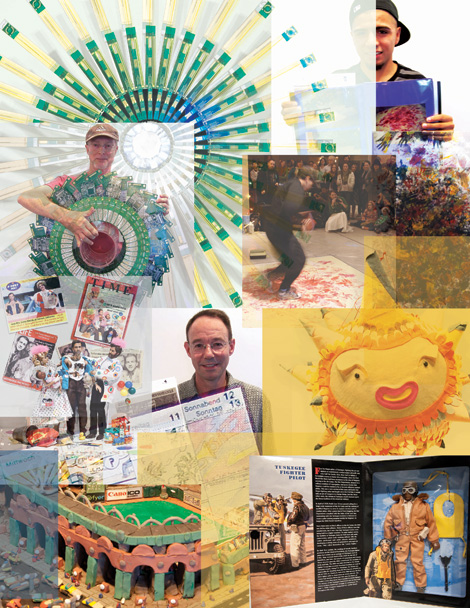
"The evening allows SMoCa to showcase its ongoing and upcoming exhibitions and introduce many of the artists to the community," says Cassandra Coblentz, the museum's curator. "It's a great opportunity for art lovers, and the art curious, to investigate the many facets of contemporary art."
The three exhibitions include two that officially open the following day, Oct. 29. The first, Kirsten Everberg: Looking for Edendale, through Jan. 8, 2012, displays the work of the Los Angeles artist, who explores the varying line between fiction and reality by focusing on the city's architectural landmarks and their interiors that have been used as locations in numerous films.
The second, artists tell stories (mostly about themselves), through Jan. 22, 2012, includes five artists who incorporate autobiography, second- and third-person voices, truth and pretense, solemnity and levity in their narratives.
The third exhibition, the traveling People's Biennial, Oct. 15 through Jan. 15, 2012 at SMoCA, is a collaboration between five lesser-known American art institutions and artists from each of the museums' states. In the Valley, seven Arizonans are participating.
Those venues, with their schedules, are Portland Institute for Contemporary Art, Portland, Ore., Sept. 10, 2010–Oct. 17, 2010; Dahl Arts Center, Rapid City, S.D., Jan. 14, 2011– March 27, 2011; Southeastern Center for Contemporary Art, Winston-Salem, N.C.; July 8, 2011–Sept. 18, 2011; Cantor Fitzgerald Gallery, Haverford College, Haverford, Pa.; Jan. 27, 2012–March 2, 2012.
Organized and circulated by Independent Curators International New York, the project is guest curated by its founders, Harrell Fletcher of Portland, Ore., and Jens Hoffmann of San Francisco, who traveled nationwide seeking under-appreciated work, especially from people who may not be considered part of the "professional" art world.
"'People's Biennial' is in some ways about democratizing the categories of creative activity typically associated with an art exhibition," says Coblentz, the resident curator for the exhibition. "By designating something not necessarily framed as Art (with a capital A), the curators are attempting to level the playing field on creative production, in a sense making it more 'democratic.'"
She adds: "Some of the artists were referred to the curators who then followed up with studio visits, some were discovered though an open call and others were selected because I toured with Harrell and Jens around town when they visited, and they asked questions and poked around."
One artist they "discovered" is Avondale resident Andrea Sweet, who had her display on view at the Bruder-designed Burton Barr Library in downtown, where she works. Her "Negro-bilia" is an assemblage of Black collectibles in an attempt to confront the ideology and "artistry" of racism.
She purchased her first mammy doll in 1980. "I wasn't ashamed or angry. Instead, I felt empowered, even slightly amused. Those ugly caricatures of coal-black faces, bulbous eyes, and protruding ruby lips filled me with a sense of the strength and resiliency of my ancestors," she says.
All the pieces are prominently displayed in her home. "I have no problem displaying them alongside the traditional artwork that fills my house," she explains. "If that offends people, good! I'm more than happy to have my collection be the catalyst for provoking thought, creating dialogue and stirring emotions. Isn't that what art is all about?"
For Phoenix muralist and artist, Paul Wilson, art is about obsessions — from '50s family photo albums, the 1972 movie Poseidon Adventure, and even a Lee Harvey Oswald doll.
"I get obsessed with a concept — and find a need for a cathartic, artistic 'release' to satisfy and indulge that obsession," he explains, noting that his chosen media include video, photographs and 3-D art pieces.
For example, focusing on the 1950s, he photographed himself as all the members of a fictional "nuclear family" and assembled these into montages. And, since 8 or 9, The Poseidon Adventure has been an obsession: "I did a feature-length video satire/remake of it in my garage in the late '90s, again playing every character."
Oswald is perhaps his most provocative obsession: Wilson creates 'dollcumentaries,' that is, dioramas and videos, all done with home-made 12-inch figures of himself and Oswald. "I don't eschew what happened then; I simply choose to go in my own direction with him [Oswald]," he says.
West Phoenix native Joseph Perez, aka "Sentrock," breakdances with paint on his hands and shoe bottoms to create canvases, which he calls "Sound in Color." He started painting in first grade and break dancing and graffiti art in high school.
"I combined my breaking art form with my painting art form, and the music inspires my dancing, which then inspires the paint strokes," says Perez, who has an art studio in downtown Phoenix.
For him, the People's Biennial has helped validate his art form. "I have had so many inquiries about my art, and once they hear that I am working with SMoCA, it's like they feel more confident in my art and who I am as in artist," he says.
Buckeye's Jim Grosbach creates complex, intricate miniature cities out of modeling clay and adds narratives.
He began working in clay at 6 and built his first city in 1955, constructing a "fantasy" around it, with a mayor, council and corporate leaders. He built two more major cities in the 1960s, and in 1977 began building the ones that stand today in his home and in People's Biennial.
"While I generally eschew publicity about the cities, I felt it important to demonstrate what can be done with a seemingly simple hobby from childhood through adulthood," says Grosbach, who compares his art to the computer game Sim-City and the narratives he creates to those in other contemporary games such as Halo, Myst, Zork Nemesis and World of Warcraft.
Phoenix artist Gary Freitas actually uses today's technology to create his sculptures. "The works are an experimental art medium utilizing the hidden and common detritus of the modern high-tech world — the printed circuit board and related components," explains Freitas, a forensic psychologist born and raised in the San Francisco Bay Area.
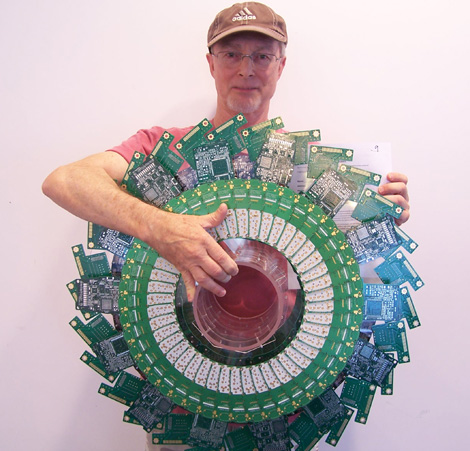
He continues: "I believe that these sculptures are among the first efforts to fully reveal the hidden nexus between science and art in this evolving consciousness.And, if current research trends hold true, these circuit board will disappear within the next decade, rendering these art pieces truly unique evolutionary artifacts as well."
In contrast, piñatas are the focus of Beatrice Moore, a Phoenix artist who owns the Kooky Krafts Shop on Grand Avenue, which specializes in handmade items by local artists and crafters.
The curators found her annual Mutant Piñata Show a perfect component for the People's Biennial. As an open call to the public, the show, with an assortment of piñatas by various artists, is not juried and every piece received is showed without distinctions.
Her inclusion in the Biennial is beneficial to the show and to all nontraditional artists and art projects, she says. "Many of these projects benefit the community as a whole and strive for a
more populist and autonomous approach to art-making and art-exhibiting."
Phoenix cardiologist David Hoelzinger hopes that calendars he created when young will also inspire his neighbors in the Valley and other exhibition visitors at the participating museums.
In Vienna, Austria, as a child, his father, who was in the paper business, annually received a calendar as a present. In the one-inch-square boxes of the dates, he began making x's, then notes, then small drawings.
"This gradually evolved into a pictorial diary, with meanings either apparent or hidden in my own symbols," he recalls. "Every picture tells a story, most of which would now be otherwise long forgotten but now serve to remind me of who I am and the people and events that are a part of me. It was also a tool for meditation and contemplation; the day was not complete until it had been so summarized."
He did this for 25 years, but his practices forced its demise. Fortunately, he found the calendars and wanted to share them. "I often asked myself, 'Is it art?' The individual drawings are usually fairly simple, but if art is taking life and converting it into a symbolic form, it fits that definition." He adds: "If just one person were inspired enough to believe that they, too, can create their own art, that would be my reward."
Coblentz sees many rewards in the People's Biennial. For one, the museums participating are in nonmainstream art communities and the artists showing are, for the most part, unknown. More importantly, the exhibition is an opportunity for everyone — artists, curators and community to rethink basic concepts, labels and categories of art. "The People's Biennial," she says, "challenges the traditional semantics and hierarchies of art, exhibitions and exhibition-making in general."
For more information on the show and the fall schedule, see www.smoca.org.
