Scottsdale is connecting extensively with Paolo Soleri this year.
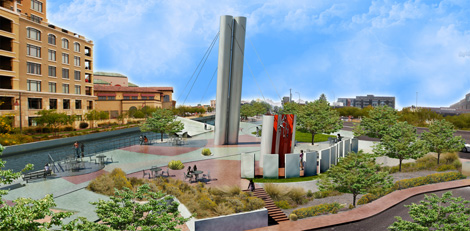
Through Jan. 23, 2011, the Scottsdale Museum of Contemporary Art continues “Bridges: Spanning the Ideas of Paolo Soleri”—the first exhibition dedicated to the bridge designs of the long-time Valley resident.
On Dec. 11, the 91-year-old architect, urban theorist, artist and philosopher will dedicate his Soleri Bridge and Plaza a few blocks north of SMoCA in downtown Scottsdale.
Supported by four stainless-steel clad pylons, the $3 million cable-stay bridge provides a pedestrian crossing over the historic Arizona Canal from the Waterfront District on the north to Old Town on the south, just west of Scottsdale and Camelback roads.
In addition, the complementary “Bridges: Connecting Earth to Sky” continues, until Jan. 17, at the young@art gallery inside the Scottsdale Center for the Performing Arts adjacent to SMoCA.
The free program displays 250 works by students from Ahwatukee’s Summit School, whose innovative Vitruvius Program, founded in 1988 by Kathleen and Eugene Kupper, builds design and architecture into basic learning as integrally as arithmetic and reading. The name honors the First Century B.C.E. Roman architect and writer.
The young people’s paintings, prints, sculptures and models respond to the Vitruvius Program as well as to the architectural and ecological vision of projects such as Soleri’s bridges, explains Laura Hales, associate curator of education at SMoCA, who also coordinates the young@art gallery, which celebrates children’s art and creativity.
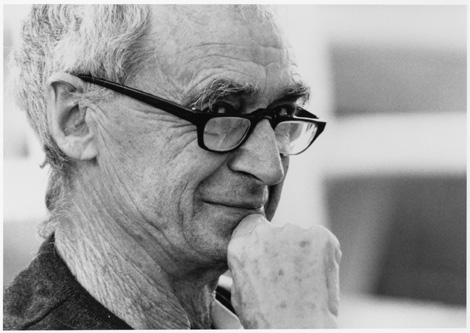
From 1955 to 1970, Italian émigré and Frank Lloyd Wright student, Soleri, with his wife, Colly, and students built his home and studio, Cosanti, in nearby Paradise Valley. That same year, 1970, he began Arcosanti, an ongoing “arcology,” uniting architecture and ecology, 65 miles north at Cordes Junction, Ariz. Today, his Cosanti Foundation continues the work, as with the construction of the Scottsdale bridge.
The Soleri Bridge and Plaza is a joint City of Scottsdale Capital Improvement Project and Scottsdale Public Art commission funded in part by Starwood Capital Group and Golub & Company, Ground Up Development Services and Salt River Project, explains Donna Isaac, senior project manager for Scottsdale Public Art.
Coordinating the bridge project is Scottsdale architect John Douglas, FAIA. Steve Martino & Associates, also of Scottsdale, is the landscape architect. The Phoenix office of Howard S. Wright Constructors is the contractor. The project includes 11 pre-cast concrete panels, each functioning as a unique artwork: These were pre-formed at Cosanti, using the same earth-casting method Soleri developed to create the buildings at Cosanti, explains Roger Tomalty, who has worked closely with Soleri for 40 years.
With his staff and the construction crew, he also completed “drip walls,” another technique innovated at Cosanti. The earth was carved into facets or a series of differing planes, reinforced concrete was cast against this surface, and a concrete slurry poured immediately on the sloping surfaces to create a drip texture. “The Soleri Bridge and Plaza is a focal point for the city’s pedestrian-oriented downtown, commissioned to enhance Scottsdale as a strong cultural tourism destination,” Isaac says. “The design team, with the fabricators and contractors, worked through many design and construction challenges. The result is an extraordinary project for the city of Scottsdale and an homage to Paolo Soleri.”
Claire C. Carter, SMoCA assistant curator, explains: “We want our visitors to move fluidly between the exhibition and, after it opens, the physical Soleri Bridge and Plaza — interacting with each site.”
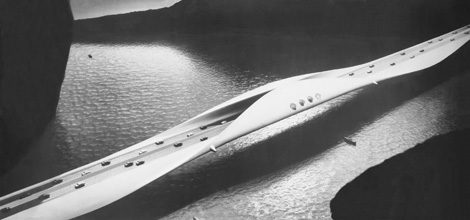
For the last 60 years, Soleri has designed bridges through drawings, models and sketchbooks. These as well as prints and multimedia presentations at the SMoCA exhibition display his concern for creating multi-purpose structures intended to pursue an environment harmonious with humanity, she adds.
Collaborating with the museum are Scottsdale Public Art and the Cosanti Foundation. The exhibition is sponsored by RBC Wealth Management and Salt River Project. Outreach assistance is by Modern Phoenix.
“Paolo Soleri began to champion the concept of arcology nearly 70 years ago, when the Arizona desert seemed endless and undisturbed by human habitation,” Hales explains. “Our present reality is urban sprawl, which makes unsustainable demands on water and energy. These are critical problems, and Soleri’s vision provides a model for creative solutions.”
Carter adds: “The exhibition demonstrates how the topography of Arizona’s canyons, as well as the scarcity of water and abundance of sunlight in our desert, informs Soleri’s bridge designs.”
The designs are beautiful, graceful and visionary, but none have been constructed until now. Still, this is historically consistent and not discreditable to Soleri, explains John Meunier, AIA, former dean of what was the College of Architecture and Environmental Design at Arizona State University, 1987–2002.
“Since the Renaissance, most bridges have not been designed by architects but by structural engineers, so they have been primarily technical marvels whose scale and economy have evoked admiration,” he explains.
“Soleri is an architect, so his bridges have also aesthetic and symbolic value,” he adds, noting that Spanish architect/engineer Santiago Calatrava, whose designs include the extraordinary addition to the Milwaukee Art Museum, has recently completed some bridges that have the qualities that Soleri's bridge designs have shown for more than a half century.
Presentations and discussions on Soleri plus expert guided tours of the exhibition follow the noontime Dec. 11 bridge dedication. These are coordinated by Phoenix resident Alison King, who founded the Web site and organization ModernPhoenix.net, which celebrates the Valley’s midcentury design history.
These events begin with the 2:30 p.m. keynote lecture by Alan Hess, architectural critic and author of Organic Architecture: The Other Modernism. Held in Stage 2 Theater inside the Scottsdale Center for the Performing Arts, “Organic Architecture and the Work of Paolo Soleri” will discuss Soleri’s work in the national context of organic architecture, including the endangered Paolo Soleri Amphitheater at Santa Fe Indian School.
At 3:30 p.m., also in Stage 2 Theater, King has invited four architects to discuss “Soleri’s Principles in Action,” in a panel format, facilitated by Tim Rodgers, Ph.D., SMoCA director, and introduced by King.
The participants are Phoenix architect Will Bruder, AIA, a disciple of Soleri and architect of SMoCA; Meunier, professor of Architecture in the School of Architecture and Landscape Architecture at ASU’s Herberger Institute for Design and the Arts; Jeffrey Stein, dean of Boston Architectural College, and Peter Zweig, FAIA, professor of Design at the University of Houston.
Admission is free to both lectures, but reservations are required. Reserve free tickets by calling 480.994.ARTS (2787) ext 2.
At 5 p.m., at SMoCA, Cosanti Foundation Director Tomiaki Tamura and Claire C. Carter will lead free public tours of the exhibition. The following day, Dec. 12, docents will also lead exhibition tours, free with paid museum admission.
“Paolo Soleri has been a towering figure in architectural and environmental creative thinking, but he is primarily known through his bells and his publications,” Meunier continues, referring to the signature windbells available at Cosanti.
“It is fitting that there should be in Scottsdale and Arizona, in a highly accessible and public place, a late example of his work that the public can experience and appreciate in a complete way, and that might persuade them to find out more about him and his important ideas.” 480.874.4666, www.smoca.org; www.scottsdalepublicart.org.
