Valley architectural firm Architekton is participating in a private-public team that hopes to certify the award-winning Tempe Transportation Center under a new program establishing voluntary guidelines and benchmarks for sustainable landscapes.
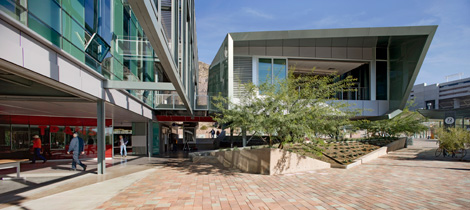
As part of the pilot Sustainable Sites Initiative™, the multi-modal center,
The SITES program is designed to encourage commercial, residential and municipal developments, with and without buildings, to create sustainable landscapes that are forward thinking and socially beneficial — promoting desirable outcomes such as cleaner water, reduced pollution restored habitats and pedestrian-friendly urbanscapes. The program is sponsored by the
“Landscapes can be designed, constructed and maintained so as to rebuild the environment’s capacity to clean our air and water, reduce the local heat island effect, provide critical wildlife habitat, reduce flooding — and even increase property values,” says John F. Kane, FAIA, LEED AP, principal of Architekton and co-designer of the Tempe Transportation Center. “We have undervalued our landscapes in terms of what they could do for us, settling for attractive landscapes that met our basic needs,” he adds. “But, they can do so much more; the potential of the landscape in the built environment is still largely untapped. SITES aims to change that.” A hub for METRO light rail, local, regional and neighborhood bus routes, the 40,300-square-foot Tempe Transportation Center in downtown Tempe opened December 2008 — funded by federal transportation dollars and local municipal sources.
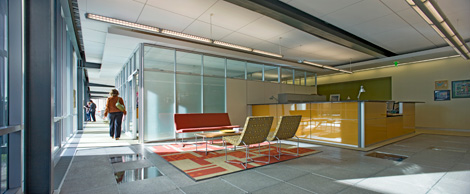
Sited on 2.7 acres below Hayden Butte, the three-story mixed-use building contains the city’s Transportation Offices, Traffic Management Center, Community Room, Transit Store, leasable office space, retail, restaurant and The Bicycle Cellar — the state’s first bike station with secure parking for 114 bikes, showers, lockers and facilities for bike purchase, rental and repair.
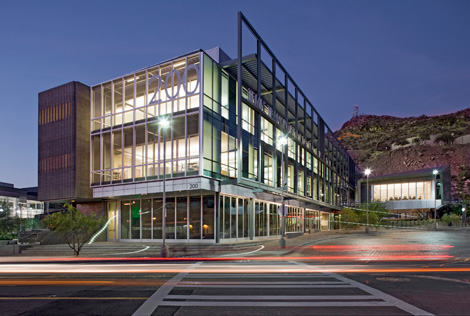
Other participants in the Transportation Center are Otak, a Portland-based firm that partnered with Architekton on the design; A DYE DESIGN, the landscape architects who made the original SITES application; the Tempe office of Adolfson & Peterson Construction, construction manager at risk; the Phoenix office of the Michael Baker Corporation, civil engineers; and the city of Tempe Transportation Division, owner and project manager. Bonnie Richardson, AIA, LEED AP, the project manager for city, will be leading the submittal process and coordinating the team’s documentation for the SITES Initiative.
“SITES highlights the potential of the landscape to do much more than merely use less of precious resources like water, energy, and time,” says Steve Windhager, director of the Sustainable Sites Initiative and of the Landscape Restoration Program at the
SITES, then, focuses on environmental factors in the same way that Leadership in Energy & Environmental Design certification, sponsored by the United States Green Building Council, focuses on structures. The USGBC, in fact, plans to incorporate a number of the credits established by the SITES program into its LEED® Green Building Rating System™. Nevertheless, SITES will be self-standing for those projects wishing to extend beyond building-centric LEED requirements as well as for those projects that do not have enough structural components for LEED certification, Windhager explains.
The
For the SITES initiative, the team is seeking credits for sustainable landscaping practices such as stormwater and graywater collection for low-water use irrigation; vegetated transit shelters; desert trees for pedestrian comfort and the reduction of heat-island effect; a sensitive site plan, respecting the sacredness of Hayden Butte to Native Americans; challenging manipulation of a transit site where visibility, not sustainability, is the primary focus; extensive daylighting and natural ventilation; a thermal-buffer green roof of desert-appropriate plants; and a water treatment system that removes minerals prior to use in the cooling tower.
“The SITES program will provide greater visibility for those elements of site design and construction that sensitively connect the community and the natural environment,” says Angela D. Dye, FASLA, LEED® AP, principal of A DYE DESIGN, a Valley landscape architect for 23 years and immediate past president of ASLA, one of the sponsoring SITES organizations. As such, she has been deeply involved with the program as well as with the
In November 2009, SITES released its pilot version with the credits acceptable in the initial rating system. Approximately 350 projects applied through the February 2010 close date, including academic and corporate campuses, public parks with hundreds of acres, transportation corridors and private homes on less than an acre. Approximately 12 percent of the participating projects are residential, Windhager notes.
In addition to the Tempe Transportation Center, four other Arizona projects were chosen for the final 175 projects in the pilot program: the Paseo Vista Recreation Area, a 65-acre Chandler park being installed on a closed landfill; the Scotland Yard Neighborhood Park in Peoria, on a vacant 8.3 acre grayfield site; Troon North Park in Scottsdale; and the Downtown Links Roadway Project in Tucson.
The
A final version of the rating system is scheduled for 2013, when SITES will open enrolment in the program for any project in the
Adds Kane: “I hope the Sustainable Sites Initiative will foster more dialogue about the importance of landscape and the site relative to the built environment. We need to think about landscape the same way we think about masonry, glass and steel.
“The idea is to integrate architecture with its site and landscape and vice versa — each needing the other, neither more important than the other, working together like a natural system.”
